Your grandfather had a leather bag. You've seen it — maybe in a wardrobe, maybe in old photographs. It's fifty years old and it looks incredible. Rich, warm, slightly beaten up in a way that makes it more beautiful, not less.
Now think about the bag you bought three years ago. The one with the peeling corners and the zipper that sticks. The one you're mildly embarrassed to carry through an airport.
The difference isn't age. It's material. Your grandfather's bag was almost certainly made from full grain leather. Yours almost certainly wasn't.
And that single distinction — full grain versus everything else — is the reason some bags last a lifetime and others barely survive a holiday.
What Actually Is Full Grain Leather?
Here's the thing most leather guides won't tell you: the term "leather" covers an absurdly wide spectrum of quality. Calling something "leather" is like calling something "wine" — it tells you almost nothing about whether you're holding a £5 bottle from a petrol station or a 1982 Château Lafite.
Full grain leather is the Lafite. It comes from the outermost layer of the animal hide — the part that faced the world, took the weather, and developed the strongest fibres as a result. Nothing is sanded off. Nothing is buffed away. Nothing is corrected or coated or disguised.
Every mark, every subtle variation in texture, every tiny imperfection — it's all still there. And that's precisely the point. Those "imperfections" are the fingerprint of the hide. They're what make each full grain leather bag genuinely one of a kind.
The Leather Hierarchy (And Why It Matters More Than You Think)
Walk into any shop and you'll see labels like "genuine leather," "real leather," "top grain," "bonded leather." They all sound reassuring. They're all designed to make you feel like you're buying quality. Most of them are lying — not technically, but in spirit.
Here's how the hierarchy actually works, from best to worst:
Full Grain Leather — The entire top layer of the hide, untouched. Strongest, most durable, develops a patina over time. This is what luxury bags, heritage boots, and high-end furniture are made from. It's expensive because it's genuinely superior, and because most hides aren't flawless enough to be used this way.
Top Grain Leather — The top layer, but sanded and refinished to remove imperfections. Thinner, more uniform, easier for manufacturers to work with. Still decent quality. Think mid-range office bags and department store wallets. It won't develop a real patina because the surface has been altered, but it'll hold up reasonably well.
Genuine Leather — This is the phrase that catches most people. "Genuine" sounds like it means "the real deal." It doesn't. It means "technically made from leather" — specifically, the lower layers of the hide left over after the good stuff has been taken. It's the hot dog of leather. You don't want to know what's in it.
Bonded Leather — Leather scraps ground into pulp and glued onto a fabric backing with polyurethane. This is the particle board of the leather world. It cracks, it peels, and it belongs nowhere near your luggage.
When you see "genuine leather" on a tag and feel reassured, that's the marketing working exactly as intended. Now you know better.
What Happens to a Full Grain Leather Bag Over Time
This is where it gets interesting. Most materials deteriorate with use. Nylon frays. Canvas fades. Synthetic leather cracks and flakes off in sad little strips.
Full grain leather does the opposite. It gets better.
The surface develops what leather artisans call a patina — a gradual darkening and smoothing that comes from oils, sunlight, touch, and time. A brand-new full grain leather bag is handsome. The same bag after two years of use is stunning. After five years, it's irreplaceable.
That's not poetry — it's chemistry. The natural oils in the leather redistribute with handling. The fibres compress and settle. Scratches blend into the surface rather than exposing a different-coloured layer underneath (which is what happens with corrected or top grain leather). The result is a depth of colour and character that simply cannot be manufactured or fast-tracked.
This is why vintage full grain leather bags sell for more than new ones. The ageing IS the value.
Vegetable Tanning: The 4,000-Year-Old Secret
Not all full grain leather is tanned the same way. The two main methods are chrome tanning (fast, cheap, uses chemical salts) and vegetable tanning (slow, traditional, uses natural tannins from tree bark and plants).
Chrome tanning takes a few hours. Vegetable tanning takes weeks — sometimes months. The leather is soaked in progressively stronger solutions of natural tannins, slowly transforming the raw hide into a material that's firm, durable, and alive with warmth.
Vegetable-tanned full grain leather — sometimes called 'pieno fiore' in Italy, which literally translates to 'full flower' — produces the richest patina and the most distinctive character over time. It starts firm and relaxes with use. It absorbs oils from your hands and develops a sheen that chrome-tanned leather never achieves.
This is the kind of leather that Florentine artisans have been working with since the Renaissance. The same tanneries. The same methods. The same results — just several hundred years of accumulated expertise.
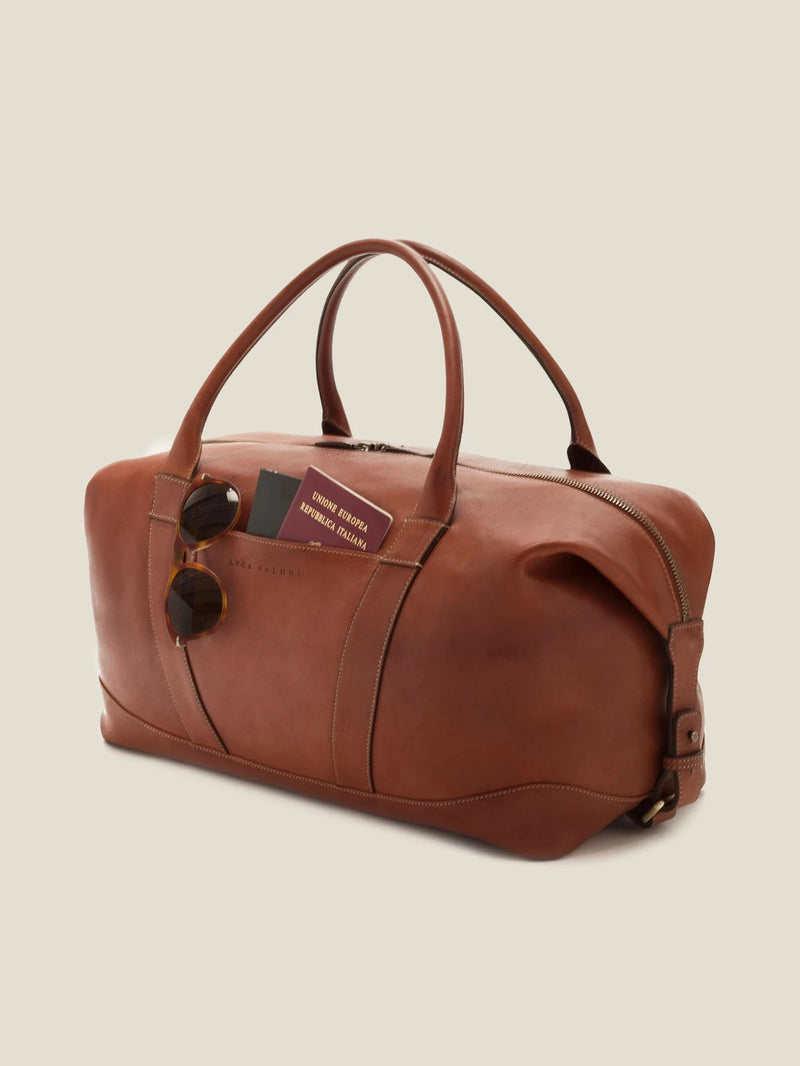
Our Luca Faloni Weekender is made from exactly this — 100% Italian vegetable-tanned full grain leather, handcrafted in Florence. It's the real thing, made the old way.
How to Spot Full Grain Leather (And How to Spot Fakes)
You shouldn't need a chemistry degree to buy a decent bag. Here's how to tell what you're actually looking at:
Look at the surface. Full grain leather has natural variations — slight colour differences, faint marks, visible pores. If the surface looks perfectly uniform and smooth, it's been sanded and refinished. That's top grain at best.
Smell it. Full grain leather has a rich, warm, slightly earthy scent. Synthetic and bonded leather smell like chemicals — a sharp, plastic-like odour that's impossible to mask entirely.
Feel the edges. Cut edges of full grain leather show a consistent, fibrous cross-section. Bonded leather shows layers — a fabric backing with a thin leather-like coating on top.
Press it. Full grain leather wrinkles naturally when you press it, like skin. Faux and bonded leather just depresses without character.
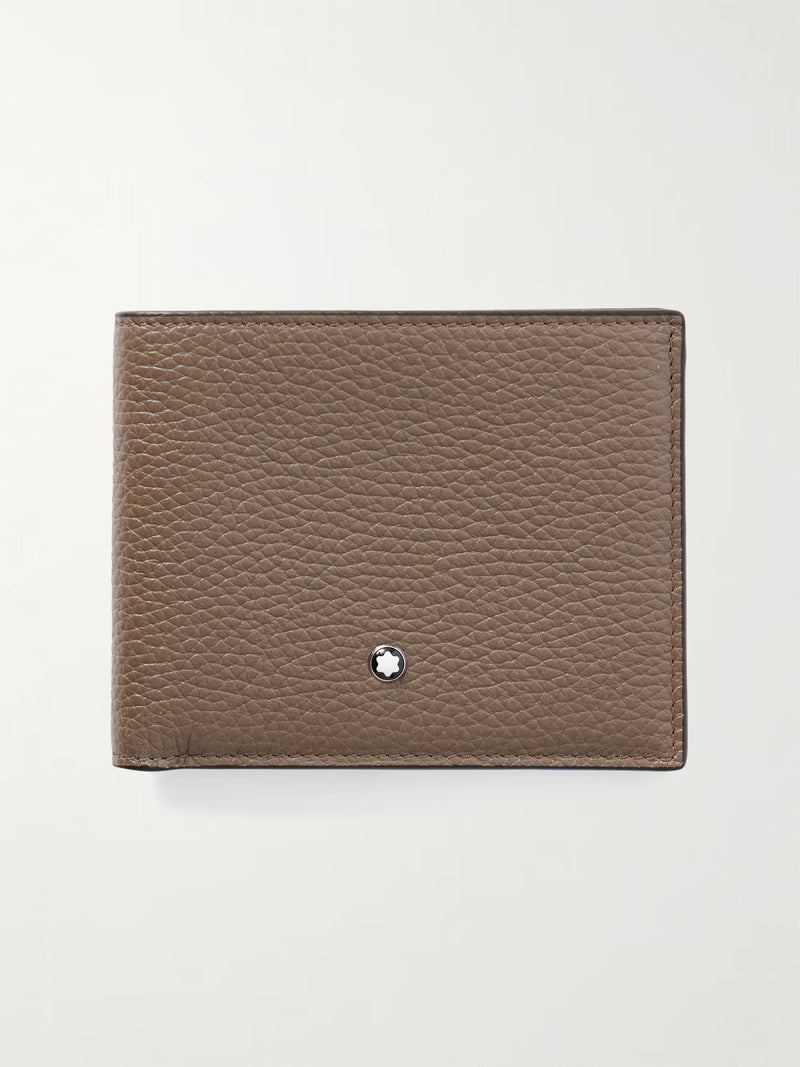
Check the price. A full grain leather bag cannot be cheap to make. If the price seems too good, the leather isn't what they're claiming. A genuine full grain leather wallet from Montblanc or a handcrafted Italian weekender will cost more — but it'll be the last one you buy.
Full Grain Leather Bag vs. Everything Else: The Real Comparison
Let's be practical about this. Not everyone needs a full grain leather bag. If you're buying a gym holdall that'll get thrown in a locker five times a week, nylon is fine. No judgement.
But if you're buying something you want to carry for years — something for travel, for weekends away, for arriving somewhere and looking like you have your life together — then the comparison isn't even close.
Durability: Full grain leather outlasts every other material by decades. The fibres are intact and tightly woven. It resists puncture, abrasion, and tearing in ways that no synthetic material can match.
Appearance over time: Nylon bags look worse after one year. Full grain leather bags look better after ten.
Environmental impact: A bag you use for thirty years has a fraction of the environmental footprint of five bags you replace every six years. Vegetable-tanned leather uses no harsh chemicals in the tanning process. And at the end of its life (which, realistically, is after your life), leather biodegrades. Your nylon holdall will be in a landfill for centuries.
Cost per use: A £500 leather bag used twice a week for twenty years costs 24p per use. A £50 nylon bag replaced every three years costs 32p per use. The expensive bag is actually cheaper.
Caring for Your Full Grain Leather Bag
Full grain leather is tough, but it rewards attention. Here's the minimum you need to do:
Keep it dry. Leather and water aren't enemies, but prolonged soaking will damage any natural material. If it gets wet, let it dry naturally at room temperature. Never use a hairdryer or radiator — heat makes leather crack and shrink.
Condition it. Once or twice a year, apply a leather conditioner with a soft cloth. This replenishes the natural oils and keeps the leather supple. Think of it like moisturiser for your bag.
Let scratches be. Light scratches on full grain leather can often be rubbed out with your thumb — the natural oils redistribute and the mark blends in. This is one of the great advantages over top grain leather, where scratches expose the corrected layer underneath.
Store it properly. When not in use, stuff it with tissue paper to hold its shape and keep it somewhere with air circulation. Not a plastic bag. Not a sealed cupboard. Leather needs to breathe.
Use it. Seriously. The worst thing you can do to a full grain leather bag is leave it unused. The oils from your hands, the natural movement, the exposure to air — all of it contributes to the patina that makes it beautiful. A full grain leather bag is meant to be lived with, not preserved behind glass.
The Investment Piece That Actually Earns Its Name
People use the phrase "investment piece" for everything now. A £40 jumper from a high street brand is apparently an "investment piece." It isn't. It's a jumper that'll bobble after six washes.
A full grain leather bag is one of the very few things that genuinely qualifies. It costs more upfront. It lasts longer than anything else you own. It looks better with age. And if you ever decide to part with it, well-maintained vintage leather holds its value in a way that no other material can.
Your grandfather knew this. He didn't read a blog post about leather grades — he just bought the good one and used it until it became part of him.
You can do the same. Start with the good one. Use it. Live with it. And in fifty years, someone will see it in a photograph and wonder how something that old can look that incredible.
Browse our collection of luxury leather gifts for him — including the handcrafted Luca Faloni Full Grain Leather Weekender and the Montblanc Full Grain Leather Wallet. Every item arrives beautifully wrapped and ready to give.